
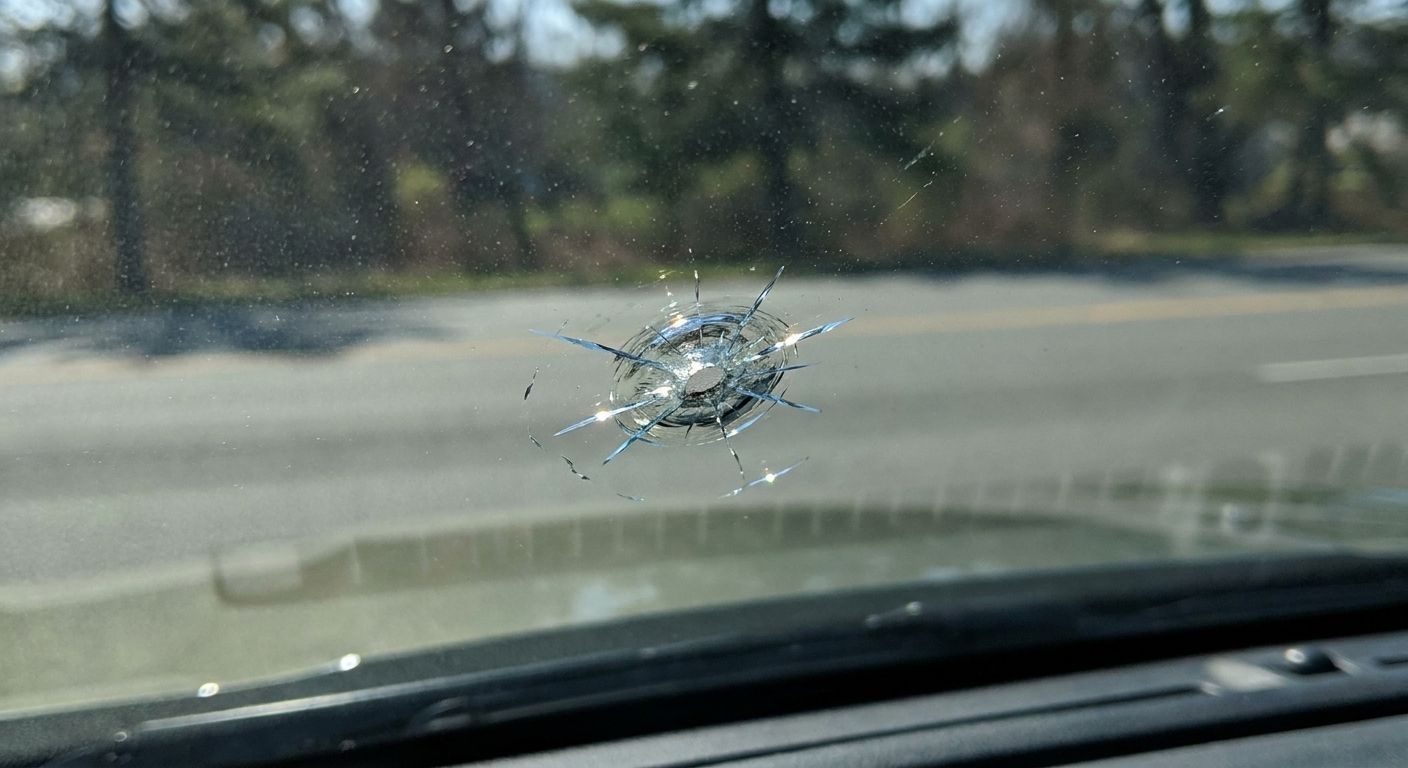
Mobile sits where I-10 and I-65 meet, and it works a deep-water port on top of that. Gulf Coast traffic running between New Orleans and Florida, freight heading north toward Montgomery and Birmingham, and container chassis moving in and out of the State Docks all funnel through the same few miles of pavement. Add the Wallace Tunnel, where four lanes squeeze down to two bores under the river, and the Mobile River Bridge and Bayway work that has kept aggregate on the deck for years, and you have a city that is unusually hard on windshields.
If you commute on either interstate here, a rock chip is not an unlucky event. It is a matter of time, and the glass on your vehicle can be looked after accordingly.
Where the Rock Actually Comes From
Most of the damage traces to a handful of places. The Wallace Tunnel approach on I-10, where four lanes squeeze down and the shoulders disappear entirely. The I-10 and I-65 interchange in west Mobile, where merging traffic runs close and trucks change lanes. The Bayway and the Causeway east of the river, where there is no shoulder and shell and gravel wash onto the deck. And the long construction stretches on I-65 north toward Saraland, where temporary lanes put you within a few feet of a loaded trailer.
The pattern is fairly consistent: the worst of it happens at highway speed behind heavy trucks, and the second worst around the port terminals and the bridge work, where aggregate washes onto the pavement after every hard rain. If your commute puts you on I-65 in the morning and down Dauphin Island Parkway or Rangeline Road in the evening, you are seeing both sources in the same day.
Laminated and Tempered: Debris Hits Your Glass Two Different Ways
Your vehicle does not have one kind of glass, it has two, and they fail completely differently.
- The windshield is laminated, two layers of glass bonded around a plastic interlayer. A stone off a trailer usually does not go through it. What it does is leave star breaks, bullseyes, and pits. The glass stays in one piece, which is exactly what it was designed to do, and people conclude it survived.
- Side and rear windows are tempered, a single heat-treated layer engineered to break into blunt pellets rather than shards. When tempered glass loses, it loses all at once. There is no partial damage to assess.
- Sunroof and moonroof glass is the most exposed panel on the vehicle when hail does come through, taking impacts straight down with no slope to deflect them. It is also the panel most likely to be overlooked in an inspection, because you have to be looking down at it to see it.
The trap is the windshield. A laminated windshield covered in small impact points has not "held up." Each one of those points is a stress riser, and the Gulf Coast then applies the two forces that turn stress risers into cracks: a thirty-degree thermal shock when a storm breaks over sun-baked glass, and constant wind loading on the highway.
The Chip You Already Have Is the Weak Point
This is the single most useful thing in this article. If you are already carrying a chip, a rock off the Causeway or a stone thrown by a truck in the Wallace Tunnel, that chip is where the next impact or the next thermal shock finishes the job. Undamaged laminated glass is remarkably tough. Glass with an existing fracture is not.
A chip repair takes well under an hour, often costs less than a deductible, and is frequently waived entirely by insurers because it is so much cheaper than replacement. Getting existing chips filled before peak summer heat is the cheapest insurance available, and almost nobody does it.
Driving the Corridors Without Collecting Damage
Most of what protects a windshield here is distance and lane choice. Ranked roughly by how much good it does:
- Any covered structure. A garage, a carport, a parking deck downtown, the covered level of a lot. This is the whole game; everything below is a fallback.
- Nose into the wind. If you cannot get out from behind a loaded truck, drop back. Stone velocity falls off quickly with distance, and the extra seconds also give you room to see debris on the pavement before you reach it.
- Pick your lane through the tunnel. Hugging the left lane into the Wallace Tunnel feels faster and puts you closest to the barrier wall, where debris collects and bounces back into traffic. The right-hand line is usually the cleaner one through.
- Cover the glass, not the paint. If you have floor mats, moving blankets, or a windshield sunshade and thirty seconds, put them over the sunroof and windshield. Body panels dent. Glass breaks and lets water into the cabin.
Pitting: The Damage Nobody Files a Claim For
A single rock chip is dramatic. The slower problem is pitting, the fine sandblasting a windshield takes from years of grit thrown off the interstate. Over a few seasons that does to the outer surface what a sandblaster would, etching thousands of microscopic pits into it.
You notice pitting at two specific moments, and both of them are on the drive to work: heading east into the sunrise or west into the sunset on I-10, when low-angle light hits the pitted surface and scatters into an opaque glare, and at night when oncoming headlights do the same thing. Pitting cannot be repaired. Resin fills a discrete fracture; it does nothing for a uniformly abraded surface. A heavily pitted windshield is a replacement, and it is a legitimate safety issue rather than a cosmetic complaint.
The same grit, plus the shell and gravel that traffic throws off the Causeway and the constant truck traffic on I-10 and I-65, is why stone chips are a routine event here rather than an occasional one.
A Ten-Minute Inspection After You Take a Hit
Do this in daylight, and do it before you file anything, so you know what you are actually claiming:
- Windshield, in raking light. Stand at the corner of the vehicle and look across the glass at a low angle rather than straight through it. Impact points that are invisible head-on light up from the side.
- Sunroof glass and its seal. Look down at the panel from outside. Check the rubber perimeter for splits, and check the headliner edge inside for damp spots.
- Side glass edges. Tempered glass that took a hit but has not let go yet will often show a chipped or clouded edge at the door frame.
- Rear window defroster lines. Impact can sever the printed grid. Run the defroster and look for a stripe that stays fogged.
- Mirror housings. Road debris cracks mirror glass and the housing that holds it, and a missing mirror is its own citation in Alabama.
- Wiper blades. Debris nicks the rubber edge. Torn blades then drag grit across freshly damaged glass, which is how a starred windshield becomes a scratched one.
Filing a Glass Claim in Alabama
Photograph everything before any work is done, including a wide shot that establishes which vehicle it is. Note the date and, if the damage happened on the interstate, the direction and approximate mile marker. Specifics make a claim much harder to question.
Road debris and storm damage both fall under comprehensive coverage. Consider handling the glass as its own claim rather than bundling it into a body estimate; after a major storm the body shop queue in Mobile can run weeks deep, and there is no reason to drive on a compromised windshield while waiting for a hood appointment. Mobile glass service can come to your driveway in Prichard or your office parking lot off Cottage Hill Road and handle it in an afternoon.
Before Your Next Commute
Get existing chips filled, replace blades that are past their life, and give loaded trailers more room than feels necessary. If you are already carrying damage and would rather not carry it through another Gulf Coast summer, call (251) 620-5777 for a free assessment.
Need Service in the Mobile Metro?
We provide mobile windshield repair and replacement throughout Mobile, Prichard, Saraland, Semmes, Theodore, Daphne, Spanish Fort, and Fairhope. Call now or fill out the form to the right for a free estimate.
Call (251) 620-5777